
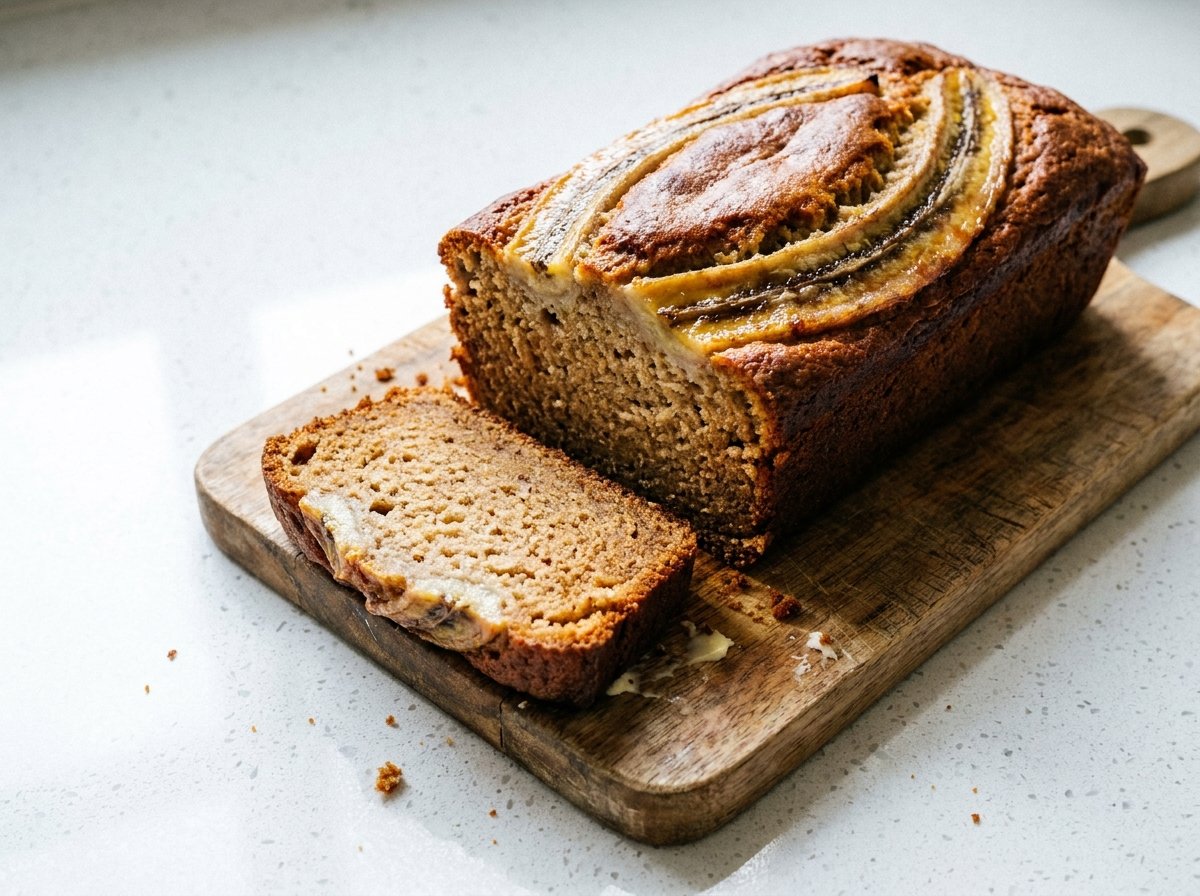
Banana Bread is the absolute king of home baking, turning those forgotten, brown-speckled bananas sitting on your kitchen counter into a sweet, golden masterpiece. There is something intensely comforting about the aroma of melted butter, caramelized sugar, and rich banana wafting through the house while a loaf bakes in the oven. You do not need fancy pastry equipment or a culinary degree to pull this off. With just a handful of standard pantry staples and a single mixing bowl, you can bake a loaf that boasts a tender, moist crumb, a cracked golden crust, and pure home-baked goodness in every bite.
The Story & The Science of the Ripened Banana
Banana Bread earned its permanent spot in American kitchens during the Great Depression. Resourceful home cooks needed a way to save every bit of food, and overripe fruit was far too valuable to toss into the trash. When commercial baking soda became widely available in the 1930s, quick bakes took off across home kitchens nationwide. What started as an exercise in frugality quickly evolved into one of the most beloved baked goods across the globe.
The real secret to an unforgettable loaf lies inside the fruit itself. As a banana ripens, its complex starches break down into simple sugars like fructose and glucose. A green banana is packed with firm, dry starches that taste chalky and lack aroma. But as the peel turns yellow, then heavily speckled, and finally dark brown, an enzyme called amylase goes to work. It transforms those starches into liquid sugar.
Green/Unripe Banana (High Starch, Low Sugar)
       ↓  Amylase Enzymatic Breakdown
Speckled/Dark Peel (Low Starch, High Sugar & Aromatic Volatiles)
That dark, speckled peel signals that your fruit is brimming with natural moisture, complex sugars, and potent aromatic compounds. If your fruit looks too bruised and ugly to eat raw, it is at the perfect stage for baking. The natural moisture in heavily brown fruit provides a incredibly moist crumb without needing heavy cream or complex wet ingredients.
When these natural sugars hit the heat of the oven, they undergo the Maillard reaction alongside the proteins in the butter and flour. This creates deep caramel and nutty notes that elevate a simple quick bread into something truly special.
Ingredient Science & Quality Deep-Dive
Every ingredient in this classic quick bread plays a specific, structural role. Understanding how these elements react ensures a perfect loaf every single time.
+-------------------+-------------------------------------------------------------+
| Ingredient        | Primary Functional Role in Batter                           |
+-------------------+-------------------------------------------------------------+
| All-Purpose Flour | Provides gluten structure, holding the loaf together        |
| White Sugar       | Sweetens, tenderizes crumb, retains internal moisture       |
| Baking Soda       | Neutralizes fruit acidity, releases CO2 for lift            |
| Salt              | Balances sweetness, strengthens gluten bonds                |
| Melted Butter     | Adds rich fat, coat proteins to prevent tough crumb         |
| Eggs              | Binds liquids and fats, provides rise through steam         |
| Mashed Bananas    | Primary flavor, natural sugars, liquid moisture base        |
+-------------------+-------------------------------------------------------------+
All-Purpose Flour
All-purpose flour forms the backbone of your bake. It contains enough protein (usually around 10% to 12%) to create a strong matrix that traps expanding gas bubbles as the loaf bakes. Using flour with too high a protein content, like bread flour, results in a chewy, tough bread. Cake flour, on the other hand, lacks the strength needed to hold up heavy mashed fruit, causing the center to collapse.
Granulated White Sugar
While sugar obviously adds sweetness, its primary technical job is tenderizing and retaining moisture. Sugar is hygroscopic, meaning it attracts and retains water molecules. This keeps your slice soft for days after baking. Additionally, as sugar dissolves into the batter, it interferes with gluten development, ensuring the final texture remains tender rather than bread-like.
Baking Soda
Baking soda (sodium bicarbonate) is an alkaline leavening agent. It needs an acid to react with to create carbon dioxide gas bubbles, which push the dense batter upward in the oven. Ripe bananas are naturally acidic (with a pH around 4.5 to 5.0). When baking soda mixes with mashed fruit, it instantly begins releasing small bubbles. This gentle chemical reaction gives your quick bread its signature lift without needing yeast.
Salt
Never skip the salt in sweet bakes. Salt cuts through the heavy sweetness, sharpens the fruity notes, and strengthens the gluten structure just enough to prevent the loaf from crumbling when sliced.
Melted Butter
Fat adds richness and coats the flour’s proteins, preventing them from forming long, elastic gluten strands. Melted butter mixes evenly into the dry ingredients, ensuring every single crumb is saturated with flavor. Using melted butter instead of softened creamed butter yields a denser, fudgier texture that defines traditional quick breads.
Eggs
Eggs act as the primary emulsifier and binder in this recipe. The proteins in egg whites coagulate under heat, forming a supportive frame around the air bubbles created by the baking soda. Meanwhile, the lecithin in egg yolks binds the melted butter and fruit moisture together into a silky, uniform batter that won’t separate during baking.
The Bananas
The star component brings sweetness, natural pectin, and deep flavor. Mashing the fruit leaves tiny chunks scattered throughout the batter, creating pockets of rich fruit flavor in every bite.
Substitutions & Dietary Adjustments
Baking is a science, but home cooking requires flexibility. Whether you are accommodating dietary restrictions or working with what is left in your pantry, you can adjust this base recipe easily.
Gluten-Free Adaptations
Swap the all-purpose flour for a high-quality 1:1 measure-for-measure gluten-free baking flour blend. Look for blends that contain xanthan gum, which replaces the structural binding properties of gluten. If your blend lacks xanthan gum, add $\frac{1}{4}$ teaspoon to the dry mixture to keep your loaf from crumbling.
Dairy-Free & Vegan Swaps
Replace the melted dairy butter with equal parts melted coconut oil, neutral avocado oil, or plant-based stick butter.
- For a substitute for eggs: Mix 2 tablespoons of ground flaxseed with 6 tablespoons of water and let it sit for 5 minutes until gelled. Alternatively, use $\frac{1}{2}$ cup of unsweetened applesauce. Note that egg-free versions will turn out slightly denser, but remain delightfully moist.
Sugar Modifications
If you want a deeper, molasses-forward profile, swap half or all of the white sugar for dark brown sugar. You can also reduce the sugar down to $\frac{3}{4}$ cup if your fruit is extremely ripe and dark, as heavily brown fruit brings plenty of natural sweetness to the bowl.
Exciting Mix-Ins
Fold up to $\frac{3}{4}$ cup of extras into the batter right at the end:
- Chopped toasted walnuts or pecans for a rich, crunchy contrast.
- Semi-sweet or dark chocolate chunks for rich melted pockets.
- Unsweetened shredded coconut paired with dried cranberries.
- $\frac{1}{2}$ teaspoon of ground cinnamon and a pinch of nutmeg for warm spice notes.
Kitchen Tools & Equipment Breakdown
Having the right gear makes baking stress-free and yields consistent results every time.
       [ Loaf Pan Material Choice ]
                  |
   +--------------+--------------+
   |                             |
[ Metal Pan ]              [ Glass Pan ]
   |                             |
   • Fast heat transfer          • Slow heat absorption
   • Sharp crust development     • Holds heat too long
   • Even internal bake          • Risk of dark, burnt edges
   (RECOMMENDED)                 (LOWER OVEN TEMP 25°F)
Pans and Heat Conductivity
This recipe calls for two 7×3-inch loaf pans, or one standard 9×5-inch pan. Light-colored aluminum or aluminized steel pans are best. They transfer heat evenly, allowing the batter to rise fully before the edges brown too deeply. Dark non-stick pans absorb heat rapidly, which often burns the outer crust before the dense center finishes baking. If using glass pans, reduce your oven temperature by 25°F (14°C) and add 5 to 10 minutes to the total bake time.
Mixing Tools
Put away the heavy electric stand mixer. Over-whisking develops gluten, turning a tender bake tough and gummy. A simple wire whisk for your dry ingredients and a sturdy silicone rubber spatula for folding wet components into dry ones is all you need.
Measuring Precision
The standard method of scooping flour directly from the bag packs it tight, adding up to 20% more flour than intended. That extra dry flour turns your loaf into a dry brick. Always fluff your flour with a fork, spoon it gently into your measuring cup, and level it off with the back of a butter knife.
Common Kitchen Mistakes & Fixes
Even straightforward recipes can hit a snag. Here is how to handle common baking issues:
The Sunken Center
- The Cause: Opening the oven door too early lets cool air in, causing the fragile structure to collapse before it sets. Alternatively, using expired baking soda leaves the batter without enough lift to hold its center.
- The Fix: Keep the oven door closed for at least the first 45 minutes. Test your baking soda by dropping $\frac{1}{2}$ teaspoon into a tablespoon of vinegar; if it fizzes vigorously, it is active and ready to use.
A Tough, Gummy Texture
- The Cause: Over-mixing the batter after adding the flour. Stirring activates gluten proteins, creating a rubbery structure.
- The Fix: Fold the wet and dry ingredients together gently with a spatula just until the dry flour streaks disappear. Stop mixing immediately.
[ Over-mixing Batter ]  →  Activates Gluten Strands  →  Tough, Gummy Crumb
[ Gentle Folding ]      →  Keeps Gluten Relaxed     →  Tender, Moist Crumb
Dark Top, Raw Center
- The Cause: The oven rack is positioned too high, or the oven runs hotter than set.
- The Fix: Bake your loaf on the middle oven rack. If the top browned deeply but a toothpick inserted in the center comes out wet, tent a piece of aluminum foil loosely over the top for the final 15 minutes of baking.
Storage, Meal Prep & Freezing Secrets
Banana Bread tastes even better the next day as the natural oils and moisture settle throughout the loaf.
+------------------+------------------+----------------------------------------+
| Storage Method   | Shelf Life       | Best Practice                          |
+------------------+------------------+----------------------------------------+
| Countertop       | 3 to 4 Days      | Airtight container with a paper towel  |
| Refrigerator     | Up to 1 Week     | Avoid! Dries out the internal crumb    |
| Freezer (Sliced) | Up to 3 Months   | Double wrapped in plastic & foil       |
+------------------+------------------+----------------------------------------+
Room Temperature Storage
Keep your baked loaf in an airtight container or sealable plastic bag at room temperature for up to 4 days. Place a dry paper towel under and over the loaf inside the container. The paper towel absorbs excess humidity, keeping the top crust from turning soggy.
The Refrigerator Trap
Avoid stashing your baked loaf in the fridge. Cold environments cause the starches in baked goods to recrystallize rapidly through a process called retrogradation, which dries out your loaf faster than room-temperature storage.
Freezing Protocol
This quick bread freezes exceptionally well. Let the loaf cool completely to room temperature. Wrap the entire loaf—or individual slices—tightly in a layer of plastic wrap, followed by a layer of heavy-duty aluminum foil. Label with the date and freeze for up to 3 months.
Reheating Techniques
- From Frozen: Let slices thaw on the counter for 20 minutes, or warm them in a toaster oven at 350°F (175°C) for 5 minutes.
- The Skillet Toast: Melt a small pat of salted butter in a non-stick skillet over medium-low heat. Toast a slice for 2 minutes per side until crisp and golden brown around the edges.
Serving Suggestions & Beverage Pairings
Banana Bread is incredibly versatile and works well for breakfast, an afternoon snack, or a relaxed dessert.
               [ Serving & Pairing Ideas ]
                            |
   +------------------------+------------------------+
   |                                                 |
[ Savory & Sweet Toppings ]              [ Beverage Pairings ]
   • Warm Salted Honey Butter               • Dark Roast Coffee
   • Whipped Cinnamon Cream Cheese           • Spiced Black Tea / Chai
   • Creamy Almond or Peanut Butter          • Cold Whole Milk
- Warm Salted Honey Butter: Whip softened salted butter with raw honey and a pinch of flaky sea salt. Spread generously over a thick, warm slice.
- Whipped Cinnamon Cream Cheese: Beat cream cheese with powdered sugar and ground cinnamon for a tangy, creamy contrast to the sweet bread.
- French Toast Transformation: Dip day-old thick slices into a rich egg, milk, and vanilla custard, then fry in butter until golden. Top with maple syrup and fresh banana slices.
- Beverage Pairings: Pair a slice with a dark roast coffee or an espresso to cut through the sweetness. A spicy chai latte or a tall, cold glass of whole milk also complements the sweet fruit profile beautifully.